







Kalpa Media House | Mysuru |
A century of service. A hundred years of organisation, sacrifice and social work And a journey that has invited both admiration and questions(Mysuru).
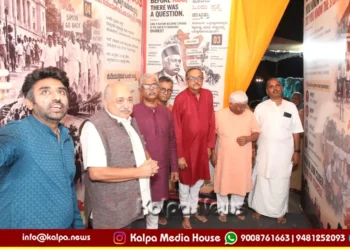
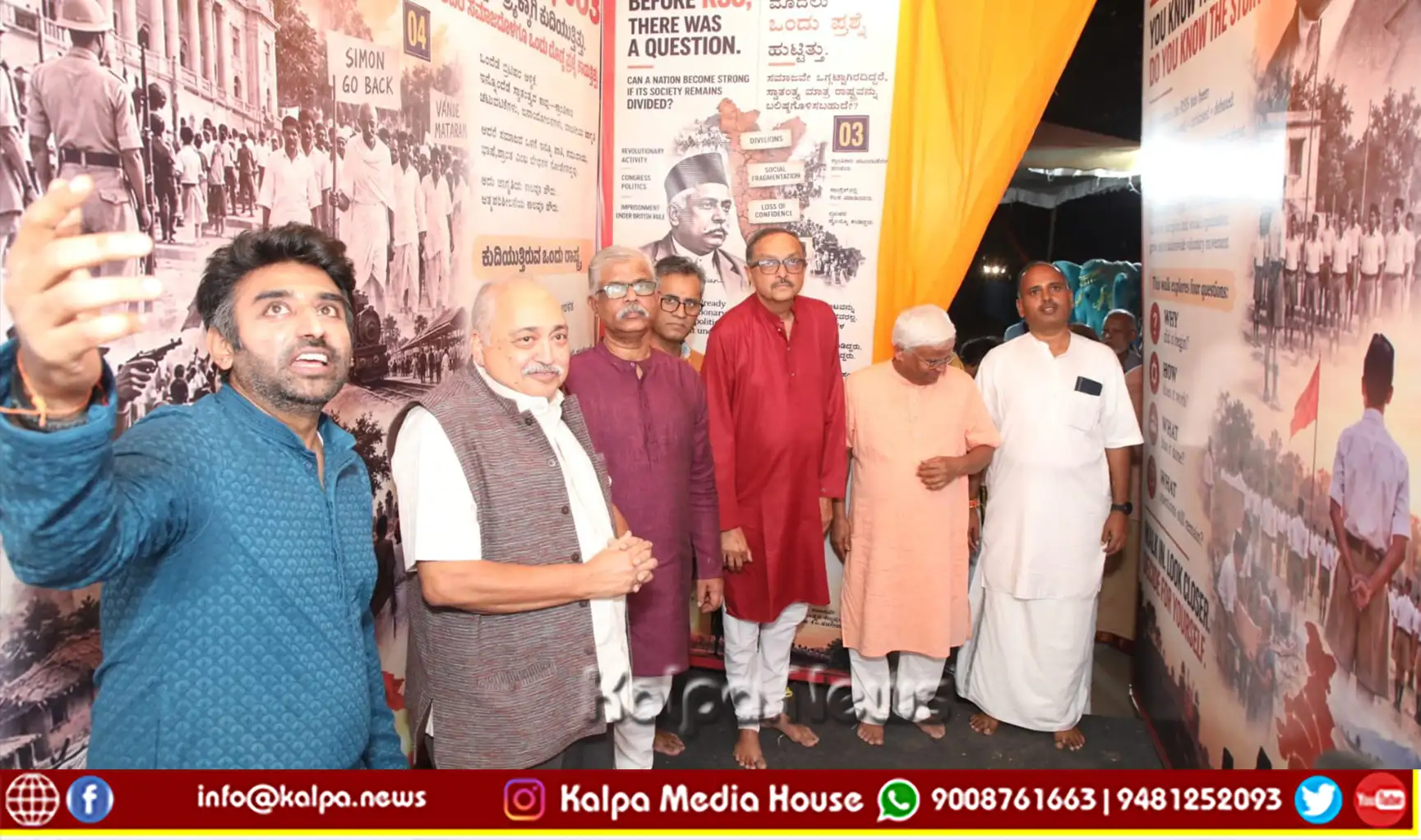
All of this comes alive at a unique exhibition being held as part of the Sri Madhava Krupa Ganeshotsava in Mysuru, offering visitors a visual journey through the 100-year-old history and activities of the Rashtriya Swayamsevak Sangh (RSS).
“Come in. Know. Experience.” — the invitation at the entrance sets the tone.
Walk through the exhibition and a larger story unfolds: Why was the RSS founded? How does it function? What happens at a shakha? Why do people attend it every day? What has the organisation done over the past 100 years? And what are the questions that continue to surround it?
The exhibition attempts to answer each of them from the organisation’s perspective, leaving visitors to form their own understanding.
The journey begins with Keshav Baliram Hedgewar, who founded the RSS in 1925, and traces the organisation’s growth over the decades. Its account of the freedom struggle is also presented, including examples of individuals associated with the wider Sangh Parivar who participated in the struggle and made sacrifices.
Mysuru : What was the RSS’s position?
At the same time, the exhibition touches upon a question that has remained part of public discourse for decades: What was the RSS’s position as an organisation during the freedom movement? Rather than avoiding the question, the exhibition places its own explanation before visitors.
Also read>> BEDA BRO Should Be Everyone’s Goal : Mysuru DCP Priyamvada calls for Drug-Free Society
Beyond history, the focus shifts to contemporary social concerns.
Social harmony, family awareness, environment-friendly living, understanding one’s ‘self’ and civic responsibilities are among the themes explored. The exhibition also addresses questions such as whether Muslims and Christians can become members of the RSS and presents the organisation’s perspective on the issue.
One of its central messages is that the comprehensive development of a country cannot depend only on changes in political leadership. A society, it argues, must also become stronger from within — through self-confidence, character, unity and organisation.
The significance of the Bhagwa Dhwaj, or saffron flag, in the RSS tradition is also explained, giving visitors an insight into the symbolism attached to it.
Interestingly, the exhibition does not restrict itself to the past. It turns its attention to Gen Z, a generation increasingly at the centre of conversations about the future of society. Information and statistics on the participation of young people in Sangh Parivar activities are showcased, along with the organisation’s narrative of how the younger generation can contribute to nation-building.
The role of women, the network of organisations associated with the Sangh Parivar and its social-service initiatives form other important sections of the exhibition.
Together, the displays create a sweeping narrative — from the birth of the RSS a century ago to its present-day activities and its vision for society.
But perhaps the most striking moment comes at the very end.
After walking through a century of history, visitors encounter a mirror.
There is no elaborate explanation. No long speech. Just a simple question:
Who is the future of this country?
The answer is not displayed on the wall.
It is reflected back at the visitor.
Expo is open till 20th September.
Contact us for News and Advertising: Whatsapp 9008761663, 9481252093 – info@kalpa.news