






Kalpa Media House | Bengaluru | Article by Rasikapriya |
The Prasanna Venkateswara Swamy Temple at Anjanapura came alive with devotion, music, dance and vibrant cultural performances during the ten-day Dasara celebrations organised in association with Natana Tarangini Academy. Held for the fourth consecutive year, the festivities provided a harmonious blend of spirituality and classical arts, with several young and accomplished artistes showcasing their talents.
Navaratri, popularly known as Dasara or Dussehra, is one of India’s most widely celebrated festivals. Observed for ten days during the Shukla Paksha of the Ashwayuja month, beginning after Mahalaya Amavasya, the festival carries profound religious, spiritual and cultural significance.
At its heart, Dasara symbolises the triumph of good over evil. Hindu mythology associates the festival with Goddess Chamundeshwari’s victory over the demon Mahishasura, Lord Rama’s triumph over Ravana, and the Pandavas successfully completing their period of exile.
Vijayadashami also has special significance in the Mahabharata. It is believed that Arjuna retrieved the weapons that the Pandavas had concealed in a Shami tree during their year of incognito exile. Worship of the Shami tree, therefore, remains an important Vijayadashami tradition in many parts of the country.
Celebration of devotion, nature and art
All the days of Navaratri are considered auspicious. Goddess Durga, Goddess Lakshmi and Goddess Saraswati are worshipped during different phases of the festival, representing strength, prosperity and knowledge.
Another colourful Navaratri tradition is the arrangement of dolls, popularly known as ‘Golu’. The tradition provides an opportunity for families, particularly women and artisans, to express their creativity while showcasing regional culture, mythology and traditional art.
Dasara celebrations in Mysuru are especially renowned for their grandeur, with the royal family continuing several time-honoured traditions. Across the country, the festival also serves as an important platform for cultural programmes, bringing together musicians, dancers and artists from diverse traditions.
Alongside religious festivities, Navaratri thus creates and nurtures cultural spaces through music, dance and other performing arts.
Natana Tarangini adds musical splendour
Natana Tarangini Academy, a music organisation that also runs a music and dance school in South Bengaluru, organises music and dance concerts at various locations in the city during Dasara every year.
One of its prominent cultural venues is the Prasanna Venkateswara Swamy Temple at Anjanapura, where the Dasara cultural celebrations were held on a grand scale for the fourth successive year.
The ten-day programme featured a series of classical music and dance performances, providing a platform for several promising young artistes.
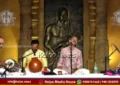
The celebrations opened with a melodious vocal concert by Ms. Supreetha, accompanied by Vid. Nishanth Rao on the violin and Chi. Srivarchas on the mridangam.
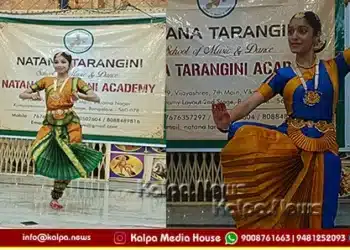
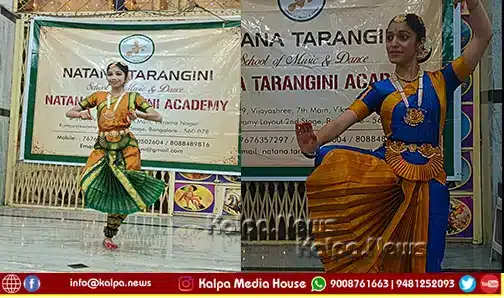
The first day’s programme featured a Veena recital by Kum. Ahika Nagadeep. On the second day, Kum. Samanvitha presented an impressive Bharatanatyam performance.
Kum. Mrudula T.N. delighted the audience with a pleasing vocal recital on the third day, while Smt. Harini Bharadwaj presented a beautiful Veena performance on the fourth day.
 Young artistes enthral audience
The fifth day’s programme featured an impressive Bharatanatyam recital by Kum. G.V. Srilasya, whose performance captivated the gathering.
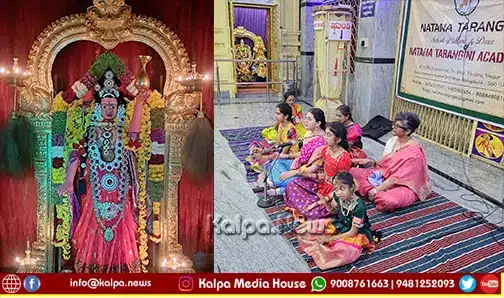
On the sixth day, Smt. Sri Bhargavi presented a wonderful vocal concert. The students of Natana Tarangini came together on the seventh day to present a Veena ensemble, adding another dimension to the musical celebrations.
On Ayudha Puja day, Smt. Manasa Mitrra presented an attractive solo Veena concert.
The celebrations culminated on Vijayadashami with a vocal ensemble presented by the students of Natana Tarangini. The performance provided a fitting finale to the ten-day musical and cultural spectacle.
The concerts received excellent instrumental support from a group of young accompanying artistes on the Veena, violin, keyboard, mridangam and ghatam. Among the accompanying artistes were Pranav Rao, Pavan Akkadaka, Taman, Srivarchas on mridangam, Ahika on keyboard and Samanvitha N.R. on Veena.
Also Read>> ಎಲೆಕ್ಟ್ರಿಕ್ ವಾಹನ ಸವಾರರಿಗೆ ಗುಡ್ನ್ಯೂಸ್: ಶಿವಮೊಗ್ಗದಲ್ಲಿ ನೂತನ EV ಚಾರ್ಜಿಂಗ್ ಸ್ಟೇಷನ್
Divine decorations enhance spiritual ambience
Adding to the splendour of the cultural performances was the magnificent decoration of the presiding deities at the Prasanna Venkateswara Swamy Temple.
Lord Sri Venkateswara and Goddess Padmavathi were adorned in elaborate and sacred decorations throughout the festivities, creating an immersive devotional atmosphere.
On different days, Lord Venkateswara was presented in various divine manifestations, including Matsya, Kurma, Varaha, Vamana, Narasimha, Rama and Krishna avatars, culminating in the magnificent Vishwarupa.
Goddess Padmavathi was beautifully adorned in different forms, including Durga, Saraswati, Lakshmi, Gayatri and Kali. The exquisite decorations, combined with classical music and dance performances, added a distinctive spiritual dimension to the celebrations.
The devotional setting of the temple, the richly adorned deities and the performances by talented artistes enthralled devotees and art lovers alike.
The ten-day Dasara celebrations at Prasanna Venkateswara Swamy Temple ultimately became more than a religious observance. They emerged as a celebration of India’s classical arts, cultural heritage and devotional traditions, creating a memorable confluence of spirituality, music and dance for everyone present.
Contact For News & Advertising : Whatsapp: 9008761663, 9481252093 – info@kalpa.news