





Kalpa Media House | Special Article : Rasikapriya |
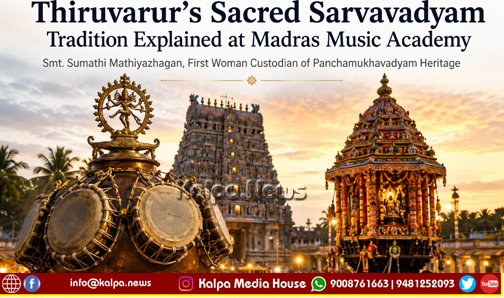
The ‘Panchavadyam’ or “Panchamukhavadyam” of Thiruvarur is a celebrated unique instrument and the Sarvavadyam tradition is an integral part of the rituals of Sri ArulmiguThyagarajaswamy Perumal at Thiruvarur.
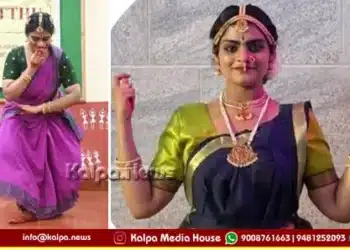
The tradition of playing this Panchavadyam has been bestowed upon the Muthukkaran family through several generations. This pleasant honour now rests with Thirumathi Sumathi Mathiyazaghan, the first lady from the family blessed to take this kainkiryam.
Sumathi Mathiazhahan comes from devaloka parampara. She belongs to the lineage of Thambiappan Muthukkaran who was the direct disciple of revered musical trinities, Sri Muthuswami Deekshithar. The credit of documenting several compositions of Deekshithar goes to Sri Thambiappan whose grandson is Thambiappan Muthukkaran, who is Smt. Sumathi’s great grand father. His son is Shankara Murthy Muthukaran, grandson Selvaraj Muthukaran. Smt. Sumathi’s lineage continues with her daughter and grandson. Smt. Sumathi gave an inspiring talk about the Panchavadyam tradition of Thiruvarur at the Madras Music Academy during the Music season in December 2025.
Bringing out the grandeur of the festivities of Thiruvarur and the importance of Panchamukhavadya in a most humble way, Smt. Sumathi elaborated the significance of instruments. The panchamukha vadyam is also known as Kudamazha.
Of the 18 angaporuzh for Thyagesha Perumal 2 important ones are Kudamazha and shuddhamaddala. They are 2 major instruments played during all the festivities at the Thiruvarur temple. Smt. Sumathi and her daughter continue to play the instrument and have kept the tradition live.
Several ancient poets have sung a lot about kudamuzha. Sri Apparswamy (also known as Thirunavukkarasar) refers to the Kudamuzha in the Thevaram hymns.
Arunagirinathar in Bhuta – Vetala vaguppu of his great Anthology, Thiruppugazh, refers to this instrument which is being played by Lord Brahma as Lord Shiva dances, in a cosmic concert. Thevaram trinities refer to muzhavu and Kudamuzhavu as being played by Nandi and Bhutaganas for Shiva’s cosmic dance. The instrument thus has a divine significance and is used much in temple rituals. Sculptures of the instrument along with Nataraja is depicted in several temples.
Thiruvarur’s 1,000-Year-Old Sarvavadyam Tradition Takes Centre Stage
According to historian, Kudavayil Balasubramaniam, Kudamuzha sculptures are seen during Chalukya and Rashtrakuta periods and that it became a Panchamukhivadya during 11th- 12th century. The earliest reference to Kudamuzha is found in the works Thiruvalangattu Thiruppathigam, of Thiru Karaikkal Ammaiyar, 5th Century Saivaite Bhakti poet, one of the 63 Nayanamars. It has been played since 1000 years.
This is called Panchamukhavadya as It has five faces. it is called kudamazha because the lower part of the instrument resembles a kodam. The instrument is like a huge vessel made of a material called ‘ mani vengalam’ a variety of bronze. Five faces of Shiva are represented in the five-faced Kudamazha, namely Ishanam, tathpurusham, aghoram, Vamadevam Satyojatham, The faces are made of various types of deer skin taken from different parts of the deer such as Eshanya from stomach region, tathpurusham, from back, other faces from lower abdominal region and hip. The reason for using deer skin is the sonorous nadam it produces. Its purpose is to arouse the kundalini. At Thiruvarur, Nartana Vinayakar will be on the kudamazha.
Sumathi’s family traditionally worship Shiva and Shakthi (Goddess Kotravai). The Muthukkaran family had a very significant association with Sri.Muthuswamy Dikshithar.
The origins or the context at which Sri Muthuswamy Dikshithar composed Navagraha krithis can be traced back to the great great grand father of Smt. Sumathi Mathiyalagan, Sri. Thambiappan Muthukkaran who used to worship Sri Thyagarajar daily while Sri Muthuswamy Dikshithar used to offer his prayers and compositions at the sanctum sanctorum of the diety.
On a certain occasion, Thambiappan did not show up. When Dikshithar enquired about him, he learnt that Sri Thambiappan was suffering from severe stomach trouble. Being a great astrologer, Dikshithar understood that wrong planetary position of Jupiter was causing the problem. Dikshithar composed the Atana Navagraha Krithi, “Brihaspathe”, which is said to have cured Sri Thambiappan from the ailment completely. Thereafter, Dikshithar composed the remaining Navagraha Krithis for the seven days of the week. Dikshithar was very well -versed in astrology, Sanskrit, Scriptures, music and was bestowed with divine power. His compositions have profound benefits when rendered correctly and with devotion. They have tremendous healing power as expressed by Smt. Sumathi Mathiyazhagan.
Thyagaraja swamy holds thirumeni rahasyam.His full physical form is rarely visible to his devotees. He and his consort are mostly covered with flowers and cloth so only the face is visible. Their feet are also concealed for most of the year. The public can have a darshan of the feet only on two days during the year, during “Aarudra darshanam“ and “panguni utthirsm” celebrations.
The Rathotsavam during Tamil ponguni month(March-April) is a spectacular event of great importance.The Thiruvarur temple chariot known as “Aazhi ther”, is famous as the biggest chariot in Asia. It is constructed using bamboo poles with special engineering techniques. The height of the chariot is raised from 30 feet to about 96 feet for the procession. The bamboo poles are of structural significance which help in manoeuvring and braking the chariot as it moves through the streets of the city. In local Tamil these bamboo poles are known as “pulle thandu”. The chariots carry Lord Thyagaraja swamy (Shiva) and his consort (Neelotpalamba (Parvathi) in a grand procession with the chariots pulled by thousands of devotees.
Before beginning the procession pulle thandu is also tied to the back of the deity, Lord Thyageshar. Once this is tied the percussionist is signalled to play the “shuddha maddala”. As is well known in the tradition, the deity does not move out straight but in a swinging movement called “Ajapa Nartana”which the deity is believed to perform without chanting. Dikshithar’s important compositions describe vividly about the unique dance as well as the traditions.
The tying of pulle thandu goes on for about 10 mts during which the playing of shudda maddalam is in a certain style. After Thyageshar is brought out in the Ajaba dance movement the God is lifted up in the air in a sudden movement , whence the playing of maddalam will be in a different tempo n style. Tieing the bamboo poles correctly is very important, else it can be disasterous. It is tied at the back of the deity as well and it has significance in rousing the kundalini. Shuddha maddalam is played at several instances, While tying the pulle thandu, smearing Chandanam (a combination of Chandan, camphor and Kumkum), and during the entire procession.
After procession the deity is taken to Sadashiva Mantapam. During poguni uttara the Abhishekam is very special. From there deity is taken to Krishna and Devasura Mantapams. This place holds lot of stories of Sundara Murthy Nayanar. The deity is known as “pinnalahar” , with a beautiful Hamsapadalankaram, with a lovely braid at the back and a nagaram at the top, symbolically representing the “Kundalini power”. One gets energised on witnessing this divine form signifying Sri Thyagarajar sitting on Maha Vishnu in Thiruparkadal. The artist continues to play maddalam all along. Then curtain to the deity is raised with grandeur followed by Deeparadhana and prasadam for the muthukkaras.
Natanamof Thyagesha is beautifully described by Dr.V. Raghavan, who hails from Thiruvarur, in a Nottuswaram that he has composed, as beautifully expressed by Dr. Sumitra Vadudev, “Vigatha raga Vigatha taala ganitha shruthi padam natasi pada vibho” Beauty of the dance while the mantram is being chanted amidst the playing of the percussion is only to be experienced. The Muthukkaran family have completely self-surrendered to the Lord.
Contact For News & Advertising : Whatsapp: 9008761663, 9481252093 – info@kalpa.news