









Kalpa Media House | Shankaraghatta |
Warning of a volatile future where “one species stands against all others,” Karnataka’s Principal Chief Conservator of Forests (PCCF) and Chief Wildlife warden, Kumar Pushkar at Kuvempu University called for an acute shift from temporary conflict mitigation to long-term habitat enrichment.
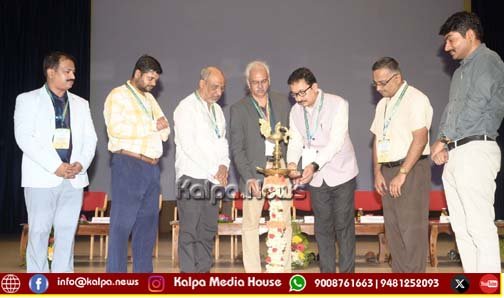
Delivering the inaugural address at the two-day National Conference on “Human-Wildlife Conflict, Co-existence and Biodiversity Conservation” (HWCCBC-2026) on Thursday at Kuvempu University’s Basava Sabha Bhavan, Mr. Pushkar, pointed out a unique paradox in Indian conservation. While the implementation of the Forest Conservation Act and Supreme Court mandates has successfully revived populations of tigers, elephants, and crocodiles, this very success has triggered a surge in conflict as human infrastructure expands into animal territories.
 “We are seeing a scenario of one species versus all others,” Pushkar remarked, noting that while other species coexist naturally, humans have struggled to adapt. He emphasized that the expansion of roads and agricultural lands into “the houses of animals” has reduced forest areas, a crisis further amplified by a modern reduction in social tolerance and the rapid spread of conflict information via social media. Highlighting the gravity of the situation, he revealed that compensation funds for conflict cases in Karnataka have ballooned from ₹18 crores to ₹70 crores in just five years, a clear indicator that temporary measures must give way to futuristic, long-term action plans.
Principal Scientist at SACON Dr. H.N. Kumara, challenging the perception of conflict as a recent phenomenon, traced its roots back 3,500 years to the Pashupati concept and Sangam literature, he reminded the audience that ancient frameworks like the Arthashastra already recognized the need for ‘Abhayaranya’, designated conservation forests meant to protect wildlife as parents of the earth rather than mere commodities.
 However, Dr. Kumara issued a stern call to the scientific community to move beyond publishing and focus on communication. “Translating research into practice is vastly different from merely publishing it,” he stated, emphasizing that policy-makers cannot implement solutions if researchers fail to approach the system with clear, actionable ideas.
Connecting these academic and policy-level discussions to the landscape at large, Bhadra Tiger Reserve DCF Pulkit Meena, emphasised that wildlife management cannot be confined to the boundaries of a forest. He noted that human activities as far as 100 kilometers away can destabilize protected areas, advocating for a total shift in mindset toward human adaptation. Meena expressed hope that the diverse collaboration at the conference would lead to concrete, on-the-ground recommendations to bolster the Forest Department’s ongoing initiatives.
 Vice- Chancellor Prof. Sharath Ananthamurthy, Registrar Mr. Hemanth N., CCF of Chikmagalur circle Yashpal Kshirsagar, Member of the Karnataka State Policy and Planning Commission Prof. T.N. Prakash Kammardi, Chairman of the Department of Wildlife and Management Prof. Vijaya Kumara were present on the occasion.
The two-day National Conference commenced on Thursday at the Basava Sabha Bhavana. The event marks a convergence of the University’s Department of Wildlife and Management and the Karnataka Forest Department to bridge the widening gap between academic research and field-level forest management.
Contact us for News and Advertising: Whatsapp 9008761663, 9481252093 – info@kalpa.news






Comments 1